Service Areas
This page provides an overview of the Honolulu and Oʻahu communities covered throughout this website. Each location page below discusses the local conditions, common tree hazards, terrain, weather patterns, and emergency tree removal situations specific to that area.
Not sure which page applies to your neighborhood? Call to describe the situation and where it's happening.
Prefer to write it out? Contact usEmergency tree removal isn't the same everywhere on Oʻahu
Two properties a few miles apart can face entirely different tree risks, simply because of where they sit on the island.
A coastal lot exposed to steady onshore wind and salt spray weathers differently than a hillside property with terraced yards and clay-heavy soil that holds rain for days. A dense urban block with narrow streets and no yard to stage equipment in calls for an entirely different plan than a suburban neighborhood with wide driveways and open lawns. A property tucked into a mountain valley catching heavy, near-daily rainfall deals with root saturation in a way a dry, leeward community rarely does.
Trade winds, mature tropical canopy, and property access all factor in as well. Oʻahu's older neighborhoods often carry decades-old monkeypod, banyan, and albizia trees that have long since outgrown the yards they were planted in, while newer planned communities carry younger, still-establishing landscaping instead. None of this is uniform across the island, which is why a single generic overview of "emergency tree removal" only tells part of the story.
The location pages below break this down by neighborhood, covering the terrain, weather, and species specific to each part of Honolulu and Oʻahu, alongside the broader service pages on emergency tree removal, storm tree removal, and hazardous tree removal.
Honolulu & Oʻahu communities covered on this site
Each location page below covers the terrain, weather exposure, and tree hazards specific to that community.
Honolulu Metro
The dense urban core of the city, mixing high-rise buildings, older residential streets, and mature street trees along its main boulevards, where access and staging space vary block by block.
View LocationWaikiki
A tightly built hotel and condo district where iconic banyan trees grow directly out of sidewalk planters, and salt air off the beachfront adds its own wear on the canopy.
View LocationAla Moana
A dense commercial and residential corridor near the shoreline, where retail landscaping, parking-area palms, and older street trees sit close to the Ala Wai Canal.
View LocationKahala
A low-density coastal neighborhood east of Diamond Head, known for spacious lots holding some of the largest mature monkeypod and banyan canopy on this side of the island.
View LocationHawaii Kai
A stretch of coastline, marina canals, and inland valleys, where salt-exposed shoreline lots and rain-fed hillside properties see very different tree risks within the same community.
View LocationKailua
A windward beach town that catches more consistent trade wind and rainfall than leeward communities, with ironwood and monkeypod common on both coastal and inland lots.
View LocationKaneohe
A windward bay-front community backed by the Koolau range, where heavier rainfall and older residential streets combine with mature canopy shaped by decades of wind exposure.
View LocationPearl City
A plantation-era community stretching from a low-lying peninsula on Pearl Harbor to elevated ridge neighborhoods, carrying some of central Oʻahu's largest legacy shade trees.
View LocationAiea
A hillside community climbing from Pearl Harbor toward the Aiea Loop Trail, where switchback streets and older residential lots hold decades-old monkeypod and mango trees.
View LocationMililani
A planned central Oʻahu community sitting in the wind corridor between the island's two mountain ranges, with younger, still-maturing landscaping compared to the island's older towns.
View LocationWaipahu
A historic plantation town on the flatter lowland near Pearl Harbor's West Loch, mixing older sugar-era shade trees with a dense residential and light industrial layout.
View LocationKapolei
A newer, growing community on the drier leeward side of the island, where younger street and yard trees haven't yet reached the size seen in Oʻahu's older neighborhoods.
View LocationEwa Beach
A leeward coastal community with lower rainfall than windward Oʻahu, where coconut palms and newer residential landscaping deal mainly with sun, wind, and salt exposure.
View LocationManoa
A university-area valley neighborhood known for some of the island's highest rainfall totals, where frequent misty rain keeps soil saturated around large, mature valley canopy.
View LocationHow the same tree emergency plays out differently by setting
Coastal neighborhoods deal with salt-laden wind and, in low-lying spots, saturated or sandy soil that anchors roots differently than inland ground. Mountain valleys like Manoa or the upper slopes of Aiea and Kaneohe catch far more rainfall than the drier leeward side, which affects how quickly root systems weaken after a storm. Suburban communities built out over the last few decades often carry younger, still-establishing trees, while older plantation-era towns hold oversized legacy canopy that has long outgrown its original yard.
Property type matters just as much as geography. Commercial districts and dense residential blocks bring access constraints a suburban cul-de-sac doesn't have to think about. Apartment communities and HOA-governed neighborhoods often add a layer of coordination with a board or property manager before any tree work can begin, regardless of how urgent the situation is.
A handful of species show up again and again across these settings, each with its own tendencies. Banyan trees develop wide aerial root systems that function as a connected structure. Monkeypod and albizia both carry broad, heavy canopies, with albizia in particular known for weaker wood. Norfolk pine, coconut palm, and royal palm round out much of the rest of the island's common tree cover, each failing in its own distinct way depending on wind, soil, and age.
- Coastal salt exposure versus inland, rain-fed soil conditions
- Mountain valley rainfall versus drier leeward communities
- Legacy plantation-era canopy versus newer, still-maturing landscaping
- Commercial, HOA, and apartment coordination versus single-family access
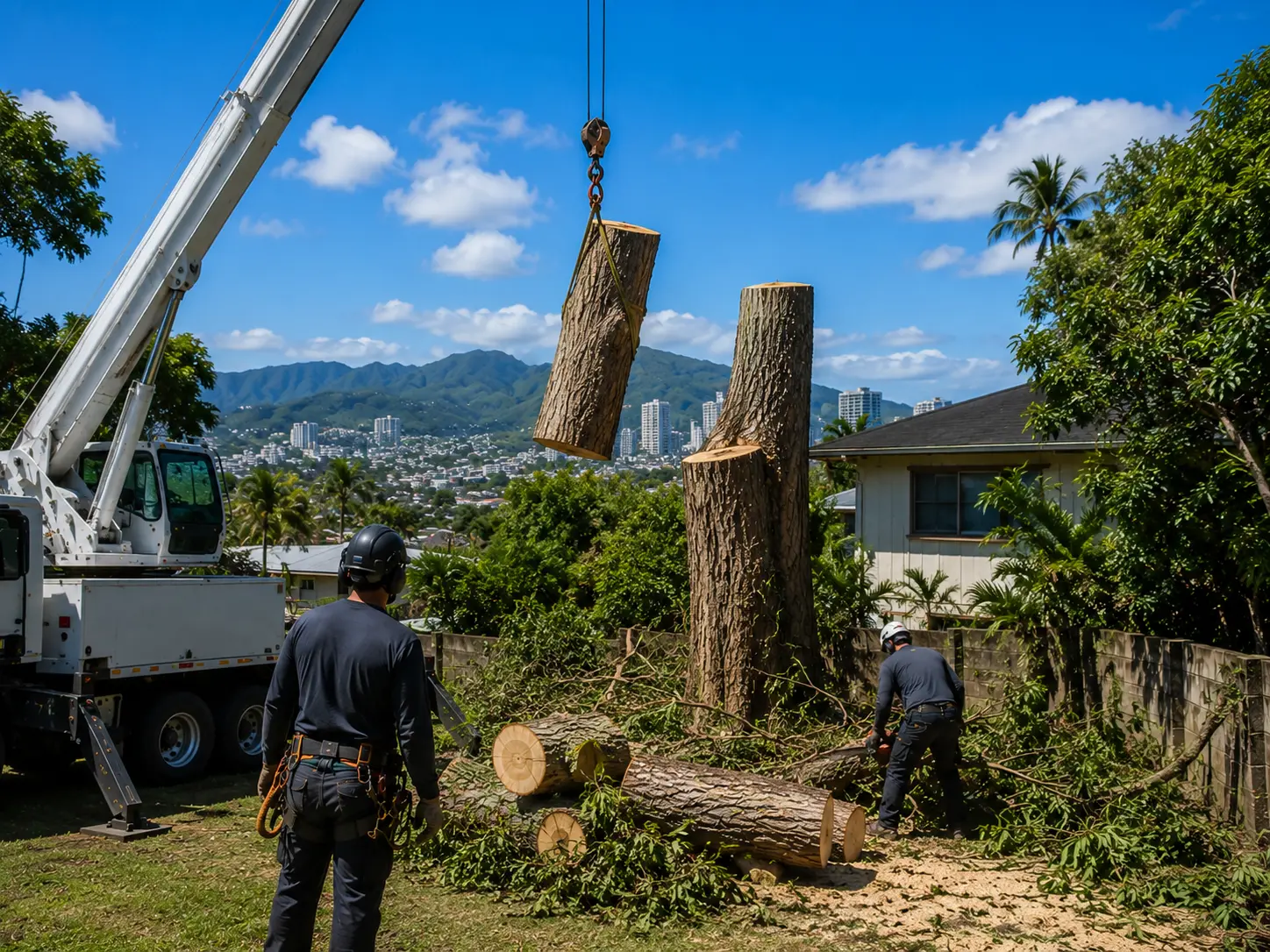
What each location page actually covers
Rather than repeating the same general information under a different neighborhood name, each location page is built around what's actually specific to that community.
Every page in the directory above includes a neighborhood overview, local weather considerations, the emergency tree situations that come up most often in that area, the tree species commonly found there, and internal links out to the relevant service pages, whether that's fallen tree removal, leaning tree removal, tree limb removal, or palm tree removal.
If you're trying to understand a specific situation rather than a specific neighborhood, the core service pages, including tree removal, storm tree removal, and hazardous tree removal, cover those topics in more depth than a location page can on its own. The two sets of pages are meant to work together: the service pages explain the situation, and the location pages explain how that situation tends to show up where you are.
A few habits worth building into regular property upkeep
Some tree emergencies are unavoidable, but a fair number of them are preceded by warning signs that were simply never checked for.
Regular Inspections
A periodic look at the canopy, trunk, and base of mature trees can catch early signs of decay or stress well before a tree becomes an active hazard.
Identifying Hazardous Trees
Dead branches, cavities, fungal growth at the base, and cracks in the trunk are all worth noting when they first appear rather than after a storm makes the problem obvious.
Storm Preparation
Ahead of forecasted wind or heavy rain, clearing loose debris and noting which trees already look stressed can make it easier to prioritize a post-storm check.
Recognizing Warning Signs
A new lean, a sudden change in canopy color, or soil that looks disturbed near the base are all signals that something has shifted and is worth a closer look.
Documenting Damage
Photographing a tree and any damage it's caused, before cleanup begins, is worth doing whether or not an insurance claim is planned.
Staying Away From Damaged Trees
A fallen, cracked, or leaning tree can still shift without warning. Keeping distance, and avoiding DIY chainsaw work, reduces the most common cause of injury in these situations.
Looking for information about your neighborhood?
Browse the location pages above, read more about a specific situation on the service pages, or reach out directly with a question.