Leaning Tree Removal Honolulu | New Lean, Real Danger
A tree doesn't lean by accident. Root failure, ground saturated by rain, or a trunk weakened from within all push a tree off center, and once that lean starts, it tends to get worse, not better. We assess the angle, the cause, and the direction before removing a leaning tree under full control.
Tell us how long the lean has been there and whether it's changed recently, and we'll advise on next steps.
Prefer to write it out? Request a free estimateAngle, direction, and root condition are checked in person before any recommendation.
Trees are guided down in a chosen direction, not left to fall on their own.
Homes, fences, and neighboring trees are factored into the removal plan.
Limbs, trunk sections, and root debris are cleared before the crew leaves.
Written, no-obligation estimates after every lean assessment.
A lean is a symptom, not the problem itself
Trees don't drift off center for no reason. A lean means something underneath has already given way, most often the root system losing its grip on one side, or a trunk that's been compromised by decay and can no longer hold the tree fully upright. The lean is the visible evidence of a failure that started somewhere you can't see.
What makes leaning trees genuinely tricky to judge is that the lean itself tends to accelerate. Once a root plate starts lifting on one side, the tree's own weight works against it, pulling harder in the direction it's already tipping with every gust of wind or heavy rain. A lean that was barely noticeable a month ago can become a visibly dangerous tilt without any single dramatic event causing it, just steady, compounding stress on roots that are already partially failed.
- Cracked or heaved soil on the side opposite the direction of the lean
- Exposed roots that have pulled partly out of the ground
- A lean that's visibly increased over days or weeks, not years
- Bark separation or splitting on the side under the most tension
If the lean is worsening right now or the tree seems close to going over, call our Emergency Tree Removal Honolulu line for the fastest response.
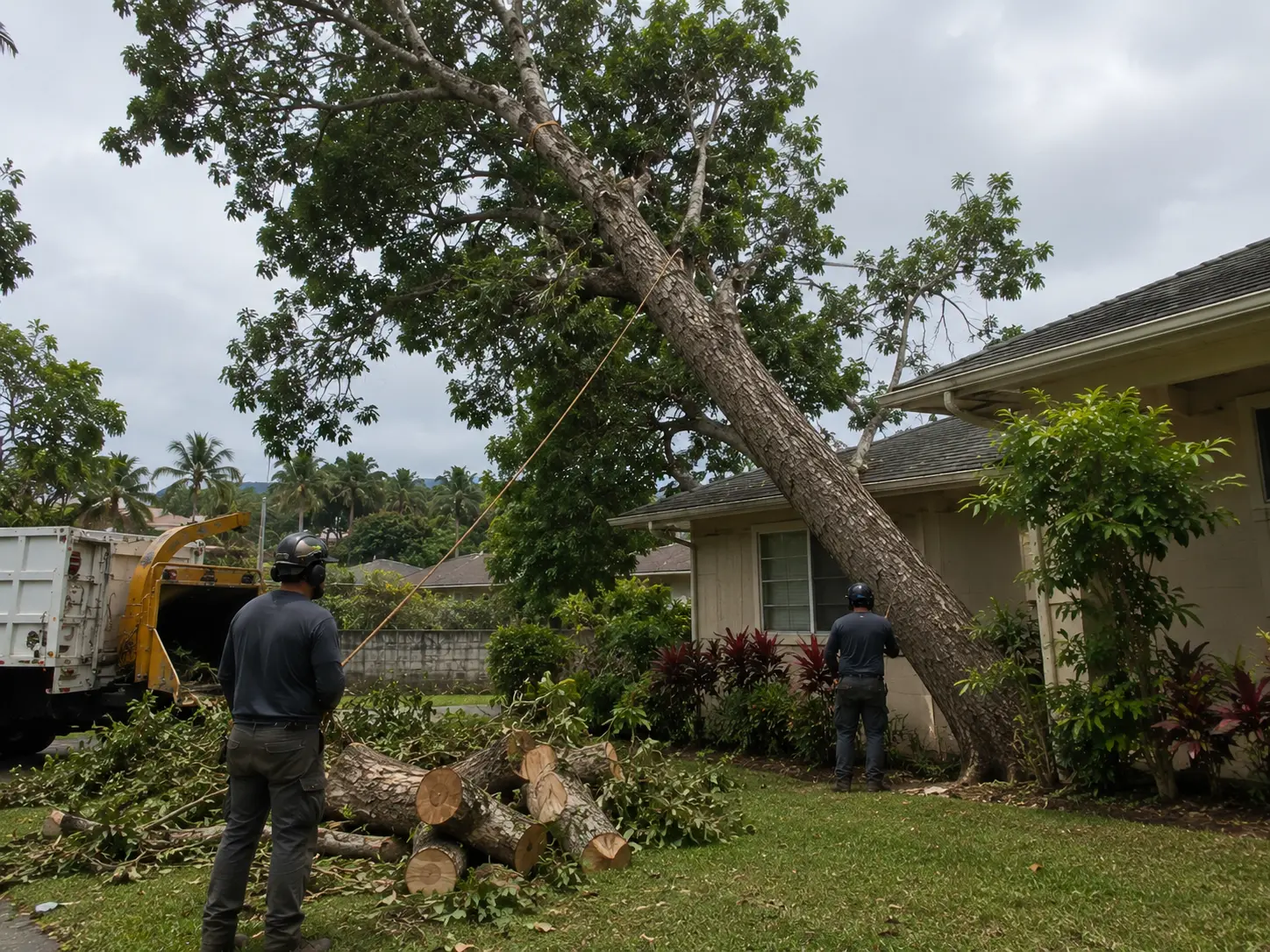
What's actually pushing your tree off center
Different causes call for different responses. Here's what we look for during a lean assessment.
Root Plate Failure
Roots on one side have torn, decayed, or simply lost their grip, letting the whole root mass tilt as a unit. This is often the most serious cause, since a partially failed root plate rarely re-anchors on its own.
Saturated, Soft Ground
Heavy rain loosens the soil's grip on roots, especially for species with wide, shallow root systems. A tree can begin leaning with no wind involved at all, simply because the ground around it can no longer hold it firmly upright.
Storm-Pushed Trunks
Sustained wind can rock a tree hard enough to loosen its anchoring without fully uprooting it, leaving a new lean in the wind's direction that continues to worsen after the storm has passed.
Trunk Decay
Internal rot can weaken the trunk enough that it bends under its own weight, producing a lean that has nothing to do with the roots at all. This type often shows a visible curve or bend rather than a straight tilt from the base.
Construction or Root Damage
Trenching, grading, or nearby digging that cuts through major roots can destabilize a tree that was previously well anchored, sometimes with a lean that only appears months after the actual damage occurred.
Lopsided Canopy Growth
A tree that grew for years reaching toward light on one side, next to a building or another tree, can develop a natural lean from uneven weight distribution in the crown, even with healthy roots.
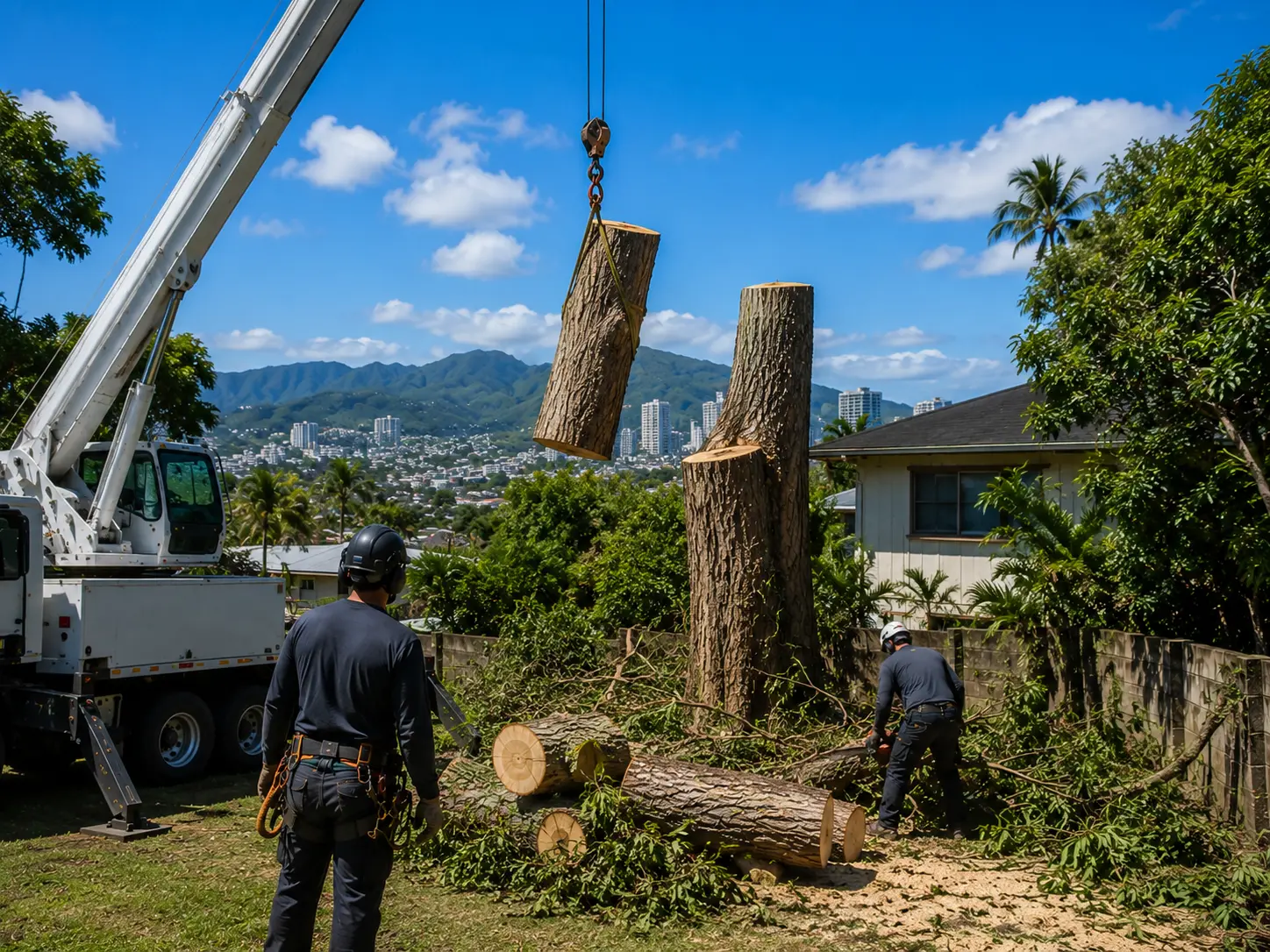
Telling a new lean apart from an old one
Some trees have grown at an angle for decades, with a trunk that curves toward light and a root system that's had years to adjust and compensate. That kind of lean, evenly weathered, with smooth bark and undisturbed soil at the base, is usually stable and not a sign of active failure.
A lean that's appeared recently looks different up close. The ground on the side opposite the tilt is often cracked, slightly raised, or shows soil that looks freshly disturbed rather than settled. Bark near the base may be splitting instead of smooth, and the whole tree can feel like it's still in motion rather than at rest. This distinction is the first thing we check, since it changes whether a tree needs immediate removal or can be monitored over time.
Removing a leaning tree in a controlled direction
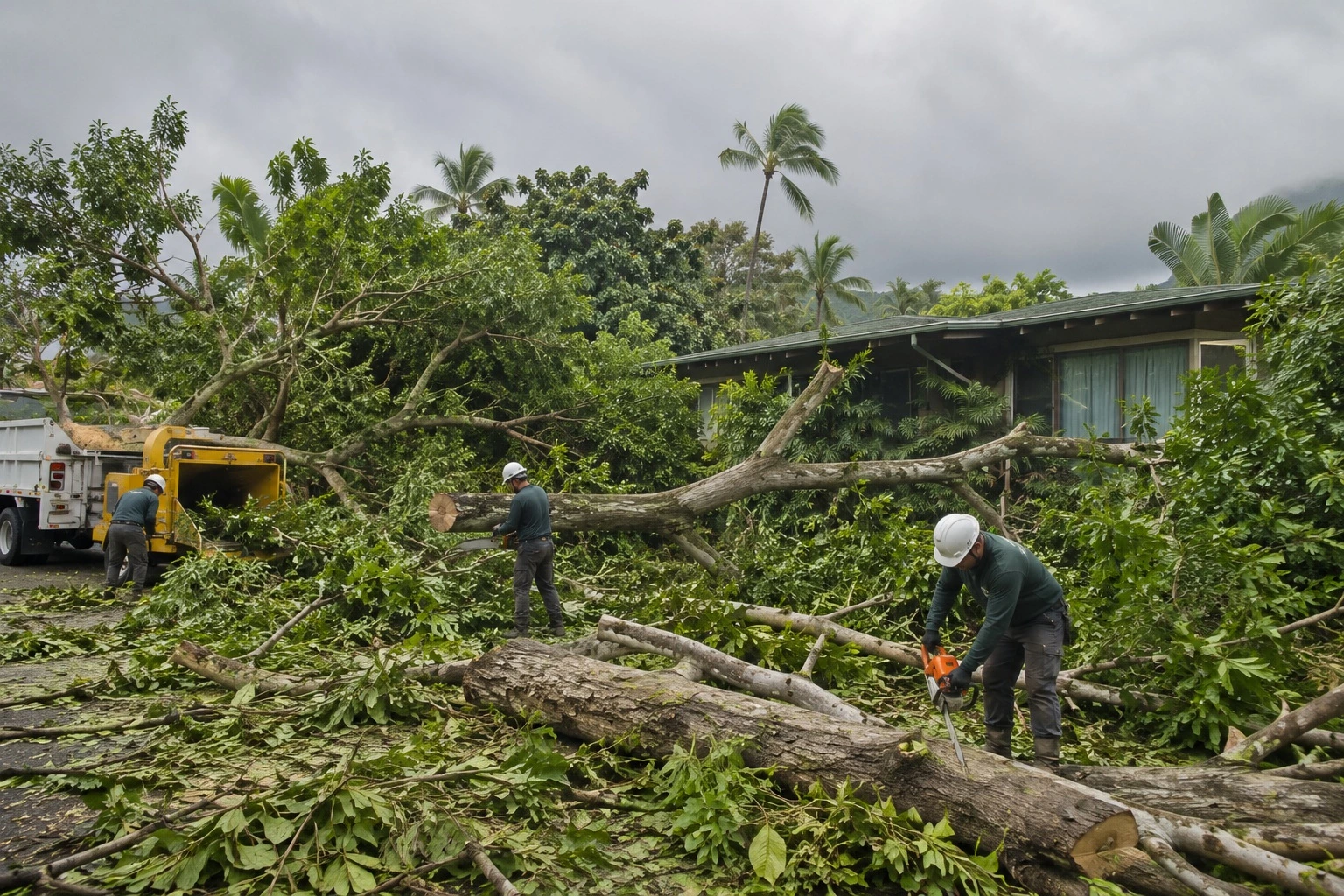
A leaning tree already has a bias built into it, its own weight is pulling it toward the direction of the lean, which changes how it needs to be approached compared to a tree standing straight. Where there's a clear, obstacle-free path in that direction, we often work with the lean rather than against it, using directional notch cuts and rigging to guide the tree down along a controlled path rather than fighting its natural momentum.
Where the lean points toward a house, a fence, or a neighboring property, felling the whole tree in one piece isn't an option. In that case, the tree is dismantled from the top down instead, with each section lowered by rope and rigging so the direction of the lean never has a chance to take over.
- Reading the lean's direction, degree, and the condition of the root plate before cutting
- Directional notch cuts that guide a controlled fall along the tree's natural lean
- Sectional dismantling from the top down when the lean points toward a structure
- Escape routes and a clear drop zone established before the first cut
For a tree that has already gone over, see fallen tree removal. For a tree with decay contributing to the lean, see hazardous tree removal.
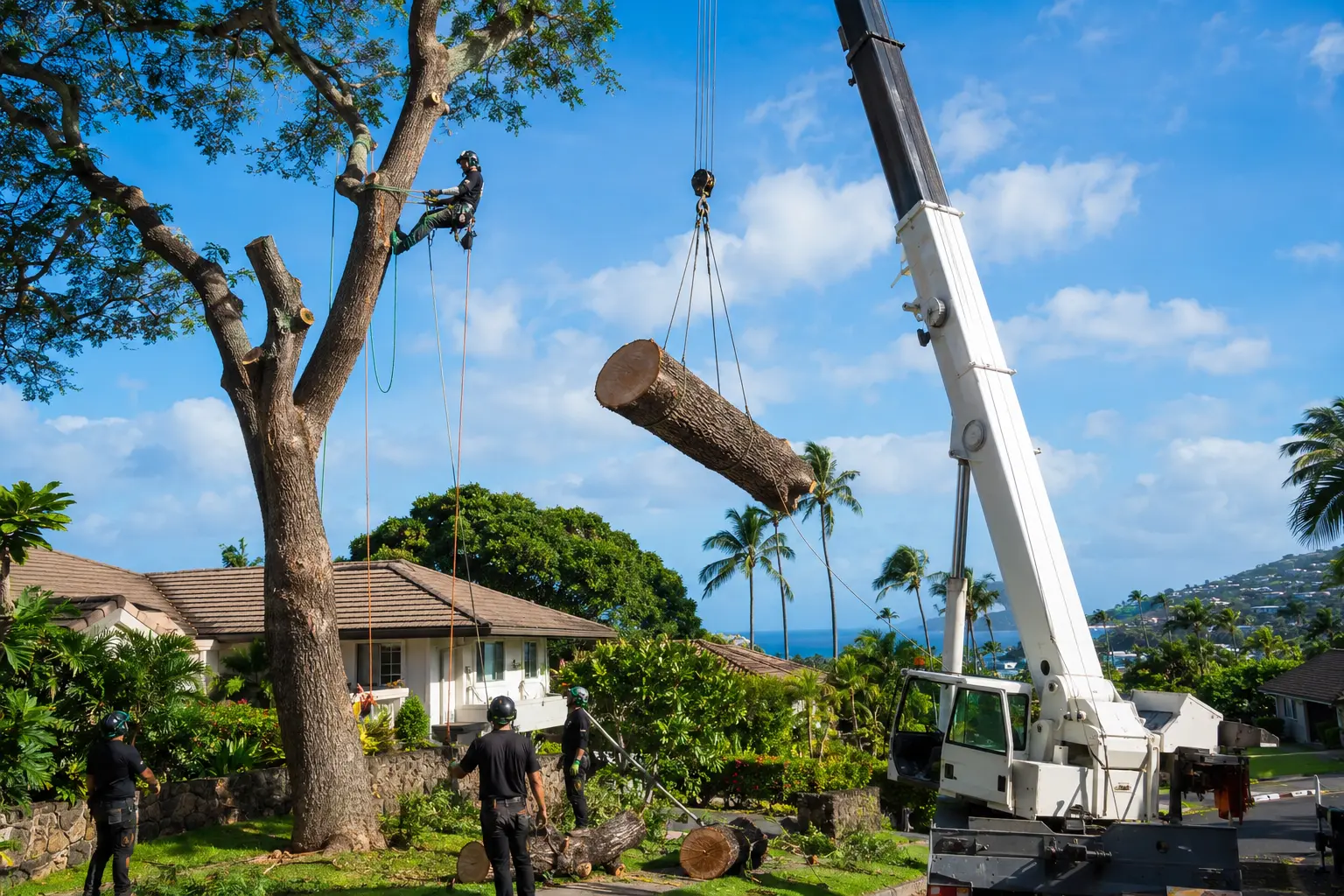
A leaning tree near a home or power line
Where a tree is leaning changes how urgently, and how carefully, it needs to come down.
Leaning Toward a Structure
A tree tilting toward a roofline or wall is treated as an active hazard, since the direction of failure is already pointed at something valuable. Sectional dismantling keeps the tree from ever reaching the structure it's leaning toward.
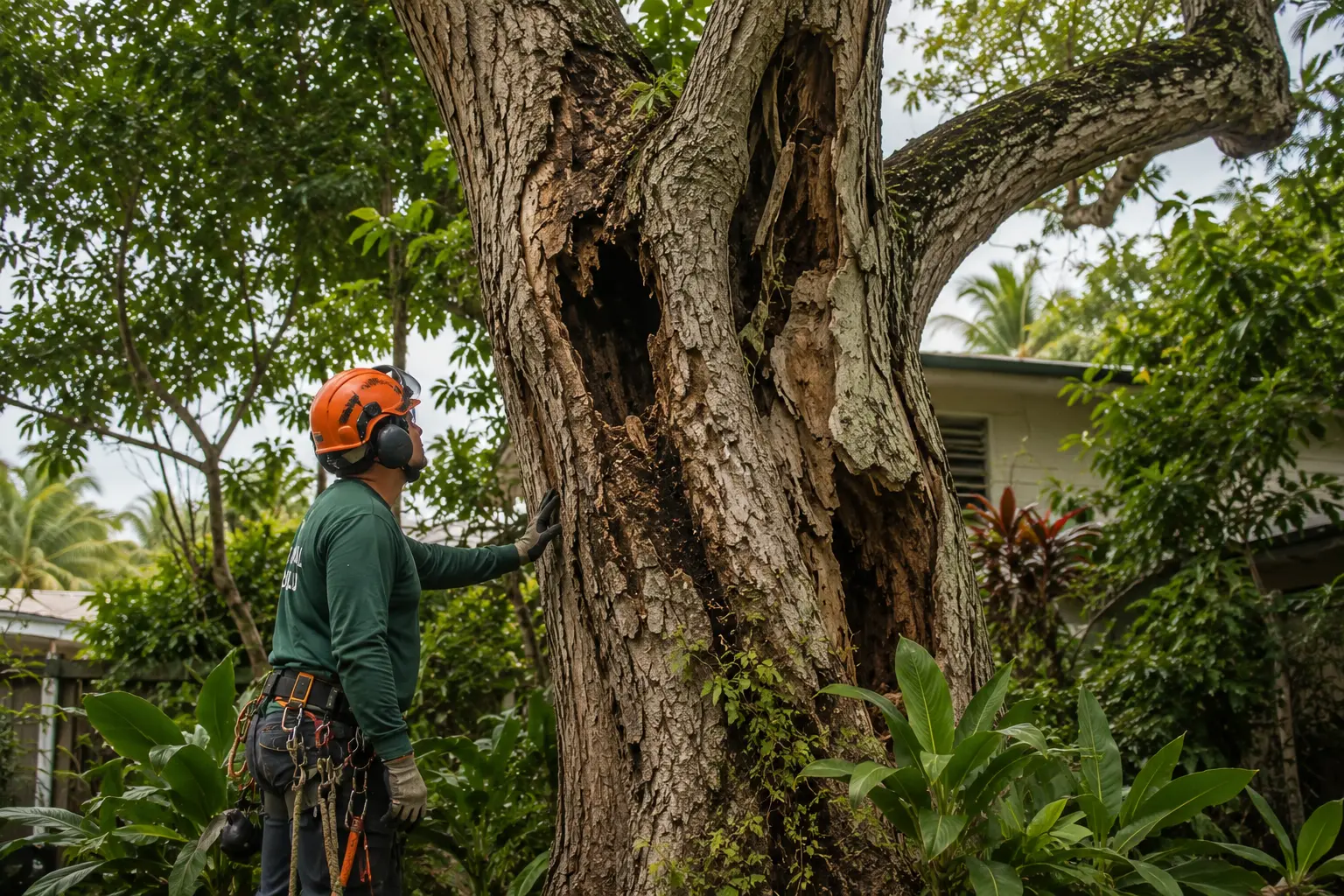
Leaning Near Power Lines
A tree leaning into or near a power line is never touched without coordinating with the utility company first. Contact with an energized line can be fatal, and this work goes to a trained crew with the right clearance.
Leaning Toward a Neighbor's Property
A tree tilting across a property line adds coordination to the job, since access and drop zones may need to account for a neighboring yard, fence, or driveway.
Which Honolulu trees lean, and why
Not all species respond to saturated soil or wind the same way. Knowing the tendency helps us judge urgency faster.
Ironwood (Casuarina)
A shallow, wide-spreading root system built for sandy, well-drained ground makes ironwood one of the species most prone to leaning after prolonged rain softens the soil.
Albizia
Rapid growth often outpaces root development, so a mature albizia can develop a lean under its own top-heavy weight even without an obvious external cause.
Monkeypod & Banyan
Their broad canopies catch enormous wind load, and a partially compromised root system on one side can show up as a slow, steady lean under that constant pressure.
Palms
Palms rarely uproot gradually the way hardwoods do; a leaning palm often signals a more advanced failure already underway. See palm tree removal for palm-specific handling.
Permits and insurance for a leaning tree
Addressing a lean early matters for more than just the tree itself.
Documentation matters before, not after
The City and County of Honolulu regulates removal of certain protected and exceptional trees, even when a tree is actively leaning and hazardous. Requirements vary by species, size, and location, and we confirm what applies during your on-site assessment.
Coverage for a fallen leaning tree depends on your specific policy, but a tree that was visibly leaning and left unaddressed can also raise questions about reasonable property maintenance. A written assessment showing when a lean was identified and how it was handled is worth keeping on file, whether the tree is removed right away or monitored first.
Our leaning tree removal process
The same careful sequence applies to a new lean discovered after a storm and a long-standing lean finally being addressed.
Call or Request
Describe the lean, how long it's been there, and whether it's changed recently.
Lean Assessment
A crew checks the angle, direction, root condition, and surroundings in person.
Written Estimate
A clear, itemized estimate is provided based on that assessment before any work begins.
Directional Removal
The tree is felled or dismantled in a controlled direction suited to the lean and surroundings.
Cleanup
Debris, root material, and wood are cleared so the property is usable again.
Honolulu's leaning tree crew homeowners trust
The same team assesses the lean and performs the removal, so nothing gets lost in translation between the two.
Every crew member is trained, and every job is backed by full insurance coverage.
Crews who know how Oʻahu's soil and species respond to rain and wind, not a mainland franchise.
A written estimate after an on-site visit, with no hidden fees added later.
The same team behind Emergency Tree Removal Honolulu handles every leaning tree call.
Leaning tree removal across Oʻahu
Lean assessments and removal available throughout Honolulu and the surrounding communities. View all service areas →
Leaning tree questions before you call
How much lean is actually dangerous?
There's no single safe angle, since it depends on the tree's species, size, root condition, and how long the lean has existed. A lean that developed suddenly, within days or after one storm, is treated as urgent regardless of the angle, because it usually signals active root or trunk failure rather than a stable growth pattern.
How can I tell if a lean is new or has always been there?
An old, established lean usually has even bark and soil settled naturally around the base with no visible cracking. A new lean often shows freshly exposed soil or cracked ground on the side opposite the lean, where the root plate is starting to lift, along with bark that may be splitting rather than smooth.
Can a leaning tree be straightened or saved?
Occasionally, a young tree with a recent, minor lean and an intact root system can be staked and monitored. A mature tree with a pronounced or worsening lean, especially one with visible root plate movement, usually cannot be corrected reliably, and removal is the safer option.
Why do trees start leaning after heavy rain in Honolulu?
Saturated soil loses much of its grip on a root system, particularly for species with wide, shallow roots. A tree that's been anchored for years can begin to shift at the base once the ground around its roots turns soft, even without any wind involved.
Is it safe to prop up or cable a leaning tree myself?
No. Bracing or cabling a leaning tree without understanding the cause and degree of the lean can give a false sense of security while the underlying root or trunk failure continues. This kind of stabilization decision should be made by an arborist after an assessment, not attempted as a quick fix.
How do you decide which direction to fell a leaning tree?
The direction is based on the tree's natural lean, the surrounding obstacles, and where the crew can safely position rigging and escape routes. In many cases the tree is guided in the direction it's already leaning, since fighting that lean with rigging alone can be riskier than working with it under control.
What if the leaning tree is too close to a structure to fell normally?
When there isn't a clear direction to drop the tree safely, it's taken down in sections instead, cut from the top down and lowered with rope and rigging rather than felled as a whole piece.
Do I need a permit to remove a leaning tree in Honolulu?
The City and County of Honolulu regulates removal of certain protected and exceptional trees, even when a tree is actively leaning and hazardous. We confirm requirements as part of the on-site assessment before removal begins.
Is a leaning tree covered by homeowners insurance if it falls?
Coverage depends on your specific policy and whether the tree damages a covered structure when it falls. A tree that was visibly leaning and known to be hazardous beforehand may also raise questions about whether it was reasonably maintained, so addressing a lean early is worth doing for more than just safety.
How quickly should a leaning tree be removed?
A lean that appeared suddenly or is visibly worsening should be treated as urgent and assessed as soon as possible. A long-standing, stable lean with no signs of active root movement can typically be scheduled with less urgency, but it should still be evaluated rather than left unaddressed indefinitely.
Request a free leaning tree assessment
Tell us how long the lean has been there and whether it's gotten worse, and a crew will follow up to arrange an on-site assessment and written estimate. If the tree is actively going over right now, call our Emergency Tree Removal Honolulu line instead.