Hazardous Tree Removal Honolulu | Dead, Decayed & Unsound Trees
Some of the most dangerous trees on a property don't announce themselves with a fallen limb or a visible lean. A hollow trunk, root decay hidden below the soil line, or a dead crown that's shed its bark all fail the same way: quietly, until they don't. We assess the tree from the roots up before recommending removal.
Describe what you're seeing, a crack, a cavity, dead branches, and we'll help you understand what it might mean before a crew visits.
Prefer to write it out? Request a free estimateA trained arborist examines canopy, trunk, base, and roots before any recommendation.
Cabling, bracing, or pruning are considered wherever they're a genuine option.
Trees near power lines are coordinated with the utility company before work begins.
A written assessment you can keep on file for insurance or liability purposes.
Written, no-obligation estimates after every hazardous tree assessment.
Why the most dangerous trees often look the most ordinary
A tree that's actively leaning or has already dropped a limb gets noticed. A tree with internal decay, a cavity healed over with new bark, or a root system quietly rotting below the surface doesn't, because none of that shows from the driveway. By the time a hazardous tree gives an obvious visual warning, the underlying problem is often already advanced.
What makes this genuinely tricky is that trees compartmentalize damage rather than heal it the way people do. A tree can wall off a decayed section internally and keep growing around it for years, looking entirely healthy in the canopy while the structural core beneath the bark has been hollowing out the whole time. That's why a hazard assessment isn't a glance from the sidewalk; it's a physical check of the trunk, the base, and the ground around the roots.
- Canopy dieback, thinning, or premature leaf drop out of season
- Vertical cracks, seams, or bulges anywhere along the trunk
- Mushrooms, conks, or other fungal growth at the base or root flare
- Soil heaving, cracking, or lifting near the base after wind or rain
If a tree is already showing an active lean or a break, treat it as urgent; see leaning tree removal or call our Emergency Tree Removal Honolulu line.
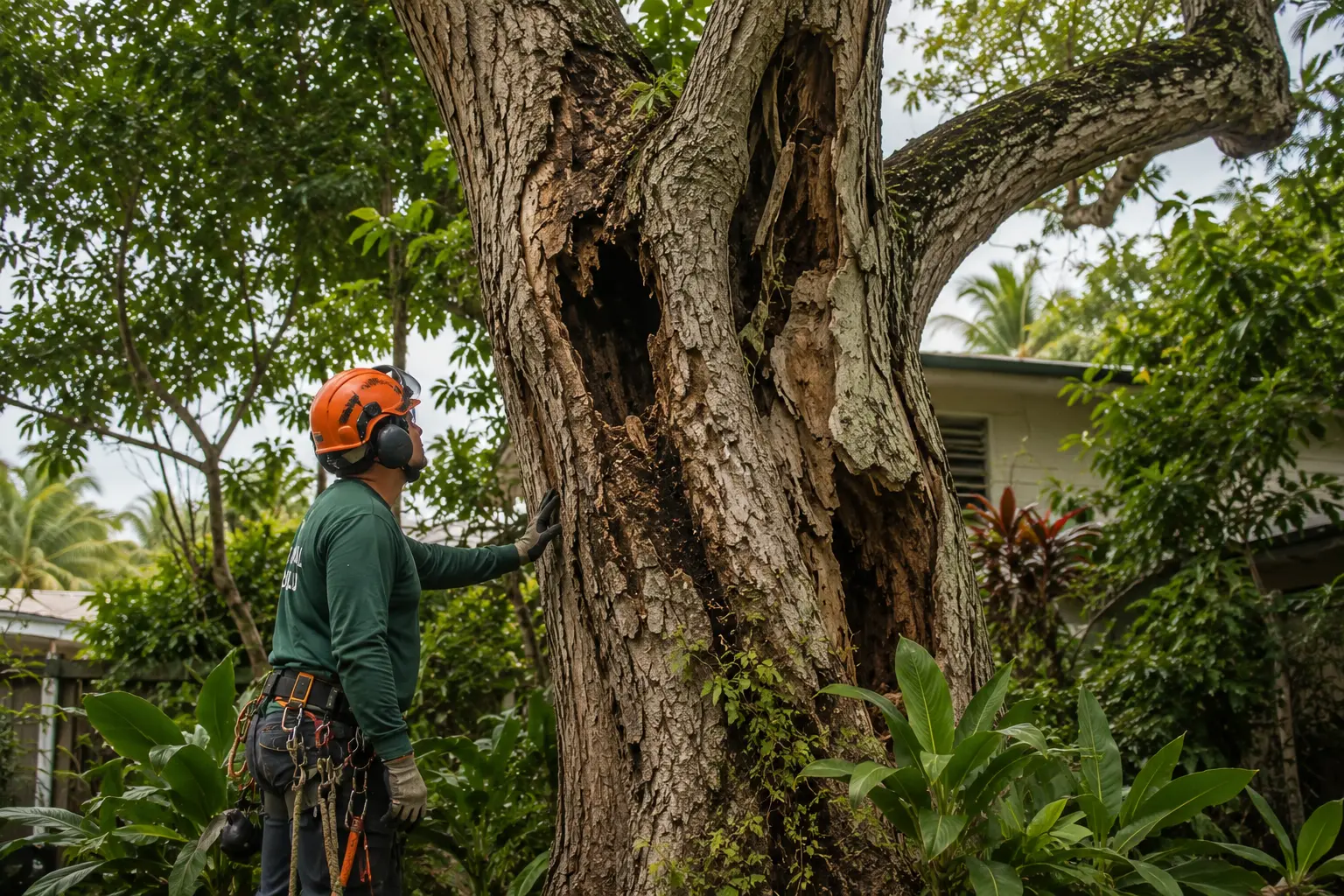
A four-point hazard assessment, not a glance
A single visual pass from the ground misses most of what actually matters. Our assessment moves through four distinct zones on every tree.
Canopy
We look for dead branches, sparse or discolored foliage, and dieback concentrated in one section of the crown, all signals that something below is interrupting the tree's ability to support that growth.
Trunk
Cracks, seams, cavities, lightning scars, and areas where the bark has separated from the wood underneath are all checked by hand, not just by sight, since some defects are easier to feel than to see.
Base & Root Flare
Fungal growth, oozing, discoloration, or a base that looks noticeably smaller in diameter than the trunk above it often points to decay working its way up from the roots.
Root Zone
Heaved or cracked soil, exposed roots that have been severed by construction or trenching, and standing water near the base all weaken the anchoring most people never think to check.
Structural defects behind most hazardous tree calls
Not every defect is created equal. Here are the ones that show up most often in our assessments around Honolulu.
Trunk Cavities
A hollow section doesn't always mean a tree is failing, but it does mean less solid wood is left to resist wind load. How much of the trunk's cross-section remains solid determines whether the tree can still safely stand.
Included Bark Unions
Where two major limbs meet at a narrow angle, bark can get trapped inside the joint instead of solid wood forming. It looks fine from outside but is one of the more common points of sudden failure, particularly in fast-growing species.
Root & Base Decay
Decay that starts in the roots and works upward is often the least visible defect and the most dangerous, since a tree can lose its anchoring well before the canopy shows any sign of stress.
When cabling, bracing, or pruning is the better call
Removal is the right answer for a lot of hazardous trees, but not all of them. A structurally weak union between two major limbs, on an otherwise healthy tree, can sometimes be reinforced with cabling that limits how far the limbs can move relative to each other. A single dead or overextended branch on a tree that's sound everywhere else can often be pruned out rather than taking the whole tree down.
Where that line sits depends on how much of the tree is actually compromised. Significant trunk decay, extensive root loss, or dieback across most of the canopy generally can't be reversed or reliably stabilized, and continuing to manage a tree in that condition tends to just delay an outcome that removal handles more predictably. We'll always tell you which category your tree falls into and why, rather than defaulting to removal as the answer.
Removing wood that doesn't behave like sound wood
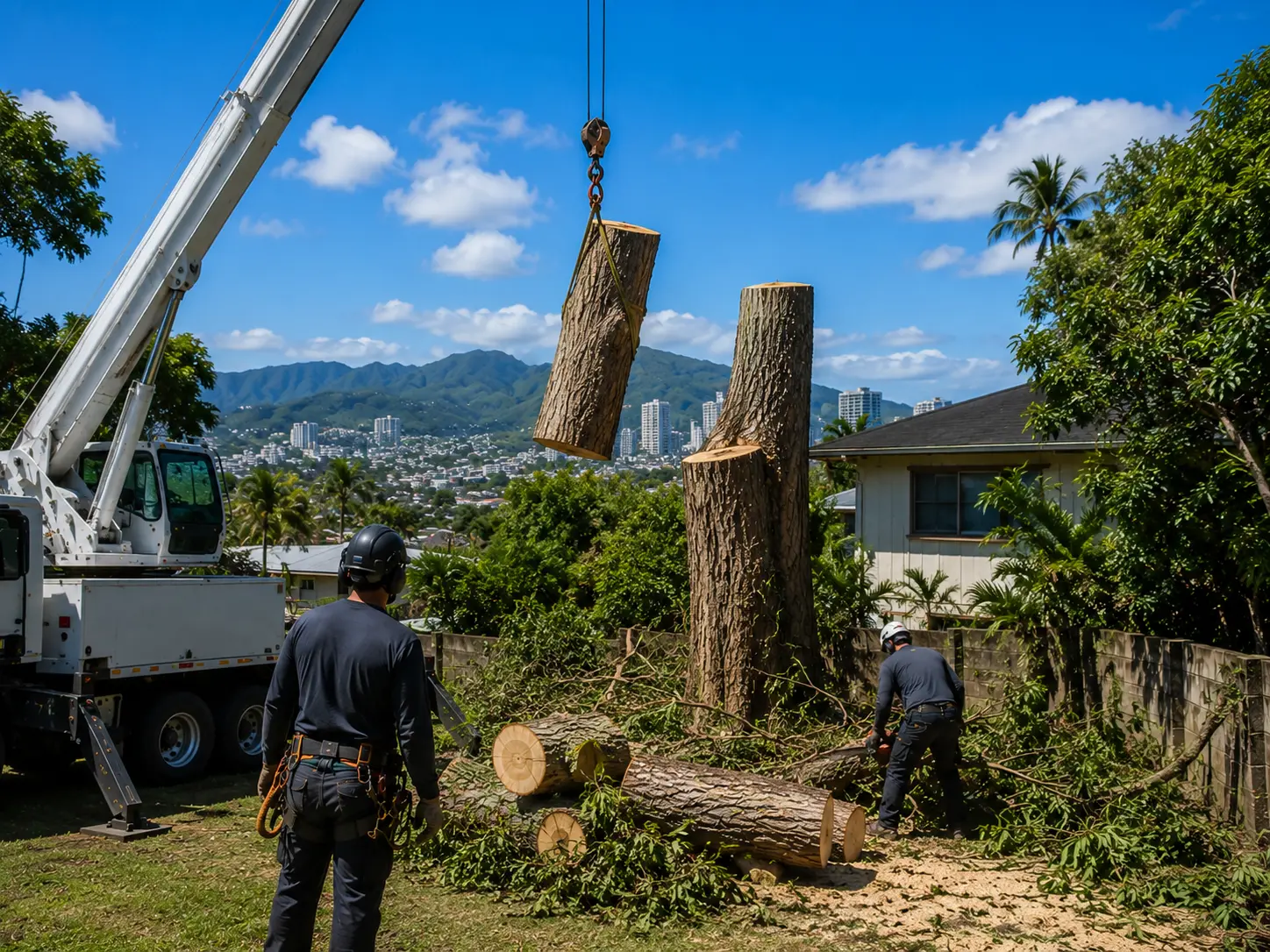
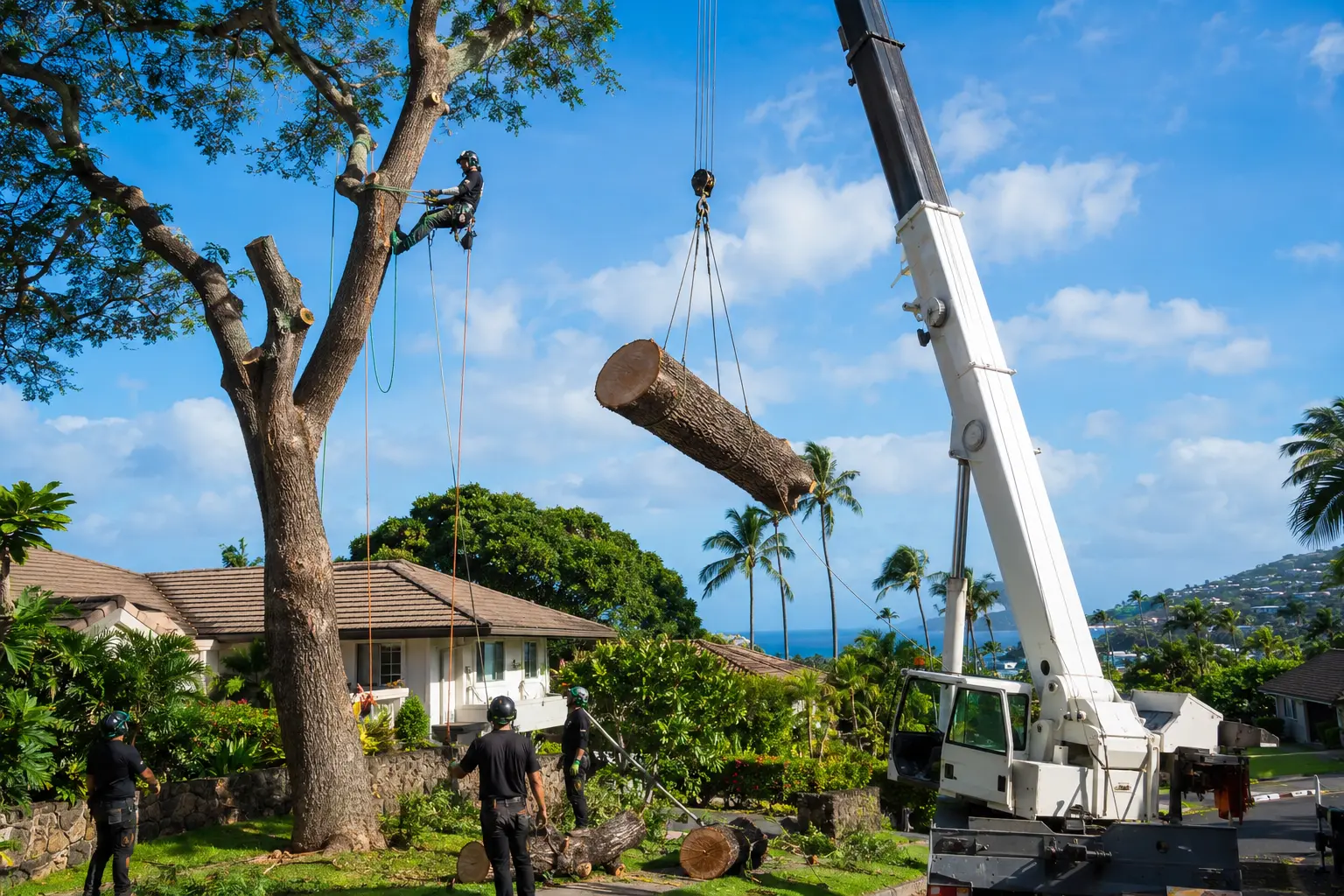
Dead and decayed wood fails differently than healthy wood, and it fails with less warning. A climber can't always trust that a limb will hold their weight the way it would on a sound tree, so hazardous removals lean more heavily on ground-based equipment, bucket trucks, and crane assistance to limit direct contact with wood of uncertain strength.
Sections are lowered with rigging rather than dropped, since brittle wood can shatter unpredictably on impact and send fragments further than expected. Where a cavity or advanced decay has been identified in a specific section of trunk, that section is treated as unreliable for the entire removal, not just the part that's visibly hollow.
- Bucket truck or crane access used more often to reduce direct climbing on compromised wood
- Sections lowered with rope and rigging rather than allowed to free-fall
- Extra clearance maintained around any section flagged as decayed or hollow
- Ground crew positioned outside the likely fragmentation radius of brittle wood
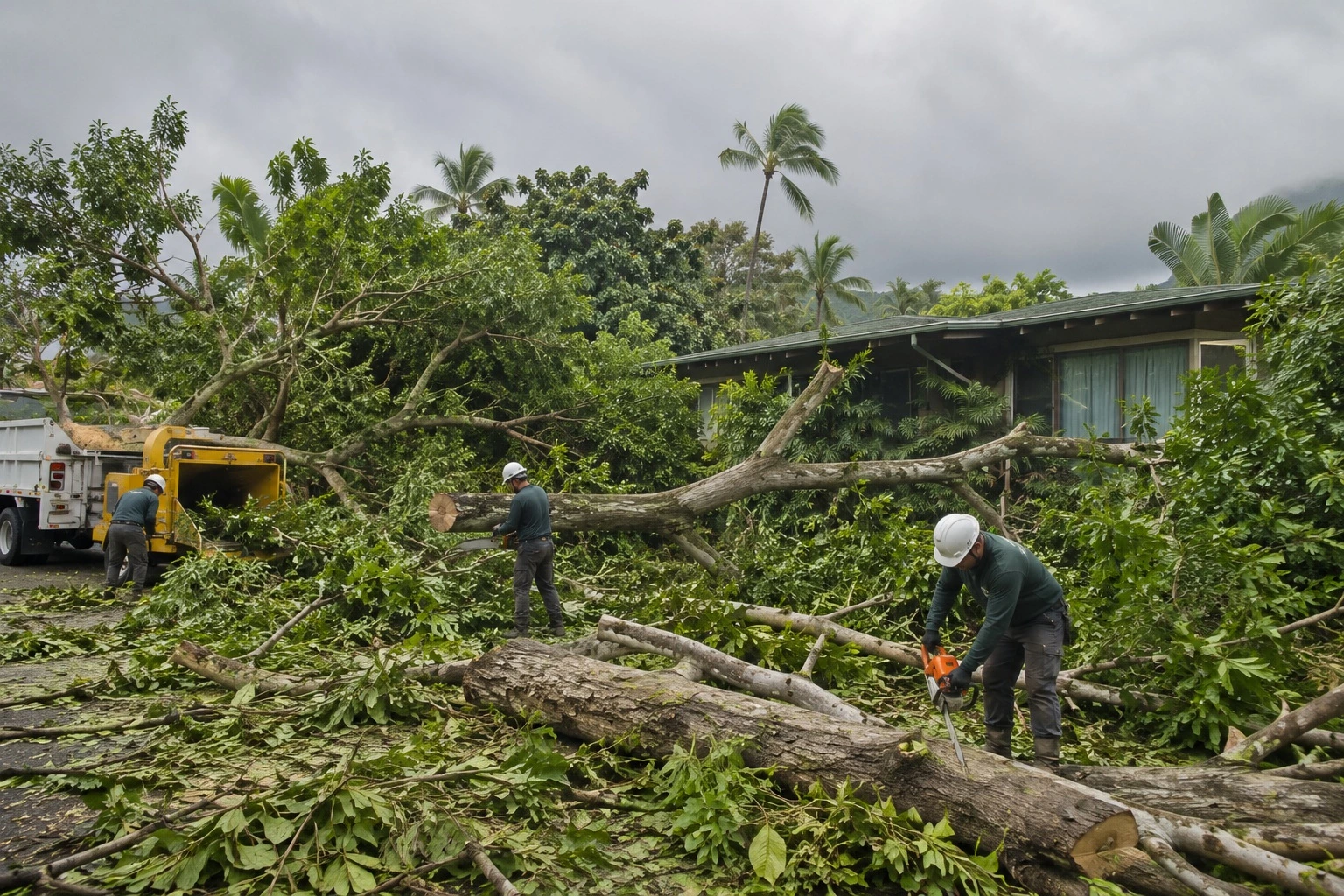
For a tree that's already fallen or leaning as a result of this kind of failure, see fallen tree removal or leaning tree removal.
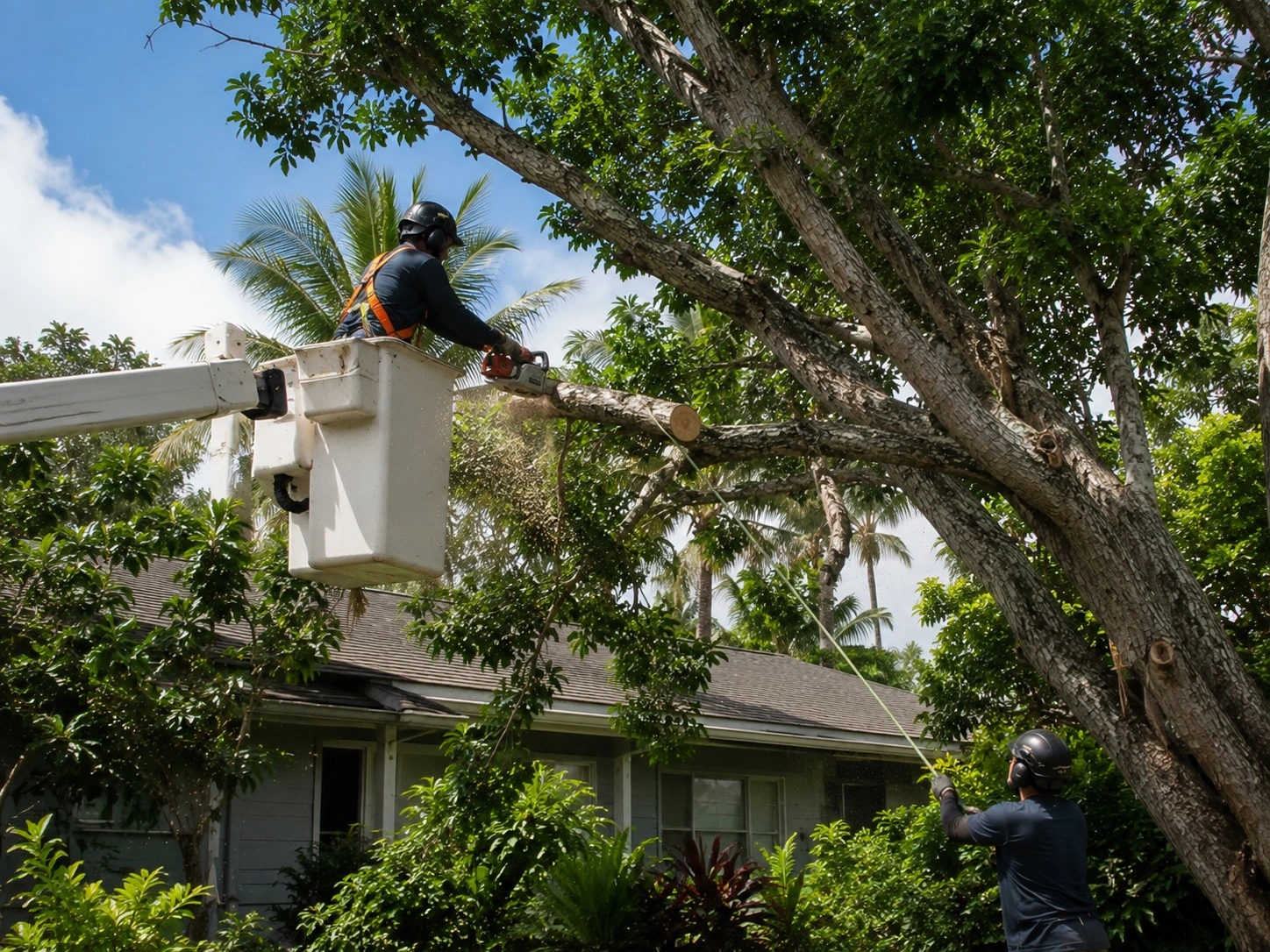
A hazardous tree near a structure or power line
The same defect carries very different consequences depending on what's within reach if the tree fails.
Near a Home or Structure
A hazardous tree within striking distance of a roofline, a carport, or a walkway moves up the priority list, since the same defect that might sit unaddressed in an open yard becomes a real liability once there's something valuable, or someone, beneath it.
Near Power Lines
A decayed or dead tree growing into or near a power line is never approached without coordinating with the utility company first. Contact with an energized line can be fatal, and this work goes to a trained crew with the right clearance, not left to guesswork.
Species we flag most often on Oʻahu
Some trees common around Honolulu are simply more prone to hidden structural failure than others.
Albizia
Fast growth comes at the cost of dense wood, and albizia is one of the species most likely to develop weak unions and sudden limb failure well before it looks obviously unhealthy.
Monkeypod & Banyan
Large, mature specimens are prone to cavities forming where old pruning cuts or storm wounds never fully closed over, often hidden well up in the trunk or major limbs.
Ironwood (Casuarina)
A shallow root system built for well-drained soil makes ironwood more prone to root-zone weakness after prolonged wet weather, even when the trunk shows no visible defect.
Aging Coconut Palms
Older palms can develop internal trunk decay near the crown that's essentially invisible until frond drop or crown failure begins. See palm tree removal for palm-specific hazards.
Permits, documentation & liability
A hazardous tree isn't only a safety issue, it's often a documentation issue too.
A documented assessment protects you either way
The City and County of Honolulu regulates removal of certain protected and exceptional trees, even when a tree is hazardous, and requirements vary by species, size, and location. We confirm what applies during your assessment, before any cutting is scheduled.
Liability for damage from a hazardous tree generally comes down to whether the owner knew, or reasonably should have known, about the defect beforehand. A written assessment showing when a hazard was identified and how it was addressed is one of the clearest records you can keep, whether the tree is removed right away or monitored for a period first. For a tree that's already caused damage, see fallen tree removal for how documentation applies there.
Our hazardous tree process
The same thorough process applies whether the tree ends up removed, stabilized, or simply monitored.
Call or Request
Describe what you're seeing, cracks, cavities, dead limbs, or fungal growth, by phone or through the estimate form.
Four-Point Assessment
An arborist evaluates the canopy, trunk, base, and root zone together, in person.
Written Findings & Estimate
You receive a clear explanation of the hazard, the recommended action, and a written estimate.
Removal or Stabilization
The tree is removed, cabled, or pruned, depending on what the assessment supports.
Cleanup & Grinding
Debris is cleared and stump grinding is completed if requested.
Honolulu's hazard-assessment crew homeowners trust
The same team that assesses hazardous trees also handles the removal, so nothing gets lost between the evaluation and the work.
Assessments performed by trained arborists, not a generalist crew guessing from the ground.
We know how Oʻahu's common tree species tend to fail, not a mainland playbook.
A written estimate after an on-site visit, with no hidden fees added later.
The same team behind Emergency Tree Removal Honolulu handles every hazardous tree call too.
Hazardous tree assessment across Oʻahu
Assessments and removal available throughout Honolulu and the surrounding communities. View all service areas →
Hazardous tree questions before you call
What makes a tree officially "hazardous" rather than just unattractive?
A hazardous tree has a structural defect, decay, dead wood, or root damage combined with something nearby it could strike, a house, a driveway, a walkway, or a place people gather. A tree with the same defect in an open field with nothing around it carries far less risk, even though the tree itself is equally compromised.
Can a hazardous tree be saved instead of removed?
Sometimes. Cabling, bracing, or corrective pruning can address some structural defects, particularly weak branch unions or a single compromised limb on an otherwise sound tree. A tree with significant trunk decay, extensive root loss, or advanced dieback usually cannot be stabilized reliably, and removal is the safer path.
What does a hazardous tree assessment actually involve?
An arborist examines the canopy for dieback, the trunk for cracks and cavities, the base for fungal growth or decay, and the root zone for damage or heaving soil. These four areas are evaluated together, since a problem in one often explains a symptom appearing somewhere else on the tree.
Is a dead tree automatically an emergency?
Not automatically, but it should never be ignored. Dead wood loses structural integrity gradually, and decay in the trunk or roots is often invisible from the ground. How urgent removal is depends on the tree's condition, size, and what's within striking distance, which an assessment can determine.
What is included bark and why does it matter?
Included bark forms where two major limbs grow from a narrow, tight union instead of a broad one, trapping bark inside the joint rather than solid wood. That union is structurally weaker than it looks and is a common point of sudden limb or trunk failure, especially in fast-growing species.
Does fungal growth on a tree always mean it needs to come down?
Fungal growth at the base or on the trunk is a signal to investigate, not an automatic removal order. Some fungi indicate significant internal decay that compromises the tree's stability, while others are more superficial. An arborist can usually tell which is which during an on-site assessment.
Is it safe to remove a hazardous tree near power lines myself?
No. Hazardous trees growing into or near power lines should only be handled by trained professionals with the right clearance and equipment. Contact with an energized line can be fatal, and the utility company is notified before any work begins near their infrastructure.
Do I need a permit to remove a hazardous tree in Honolulu?
The City and County of Honolulu regulates removal of certain protected and exceptional trees, even when a tree is hazardous. Requirements vary by species, size, and location, and we confirm what applies as part of your on-site assessment.
How is a dead or decayed tree removed differently than a healthy one?
Dead and decayed wood can fail unpredictably under load, so it's treated with more caution than sound wood. Climbers avoid putting full weight on questionable limbs, sections are often lowered rather than dropped, and equipment like a bucket truck or crane is used more frequently to limit direct contact with unstable wood.
Am I liable if my hazardous tree damages a neighbor's property?
Liability generally depends on whether the tree owner knew or reasonably should have known about the hazard beforehand. A documented professional assessment is one of the clearest ways to show a hazard was identified and addressed, which is worth keeping on file regardless of the outcome.
How much does hazardous tree removal cost in Honolulu?
Cost depends on the tree's size, condition, how much of it is compromised, accessibility, and proximity to structures or power lines. A written estimate after an on-site assessment is the only reliable way to know the cost for a specific tree.
Request a free hazardous tree assessment
Tell us what you're seeing, cracks, cavities, dead branches, or fungal growth, and a crew will follow up to arrange an on-site assessment and written estimate. If the tree is actively failing right now, call our Emergency Tree Removal Honolulu line instead.